News Story
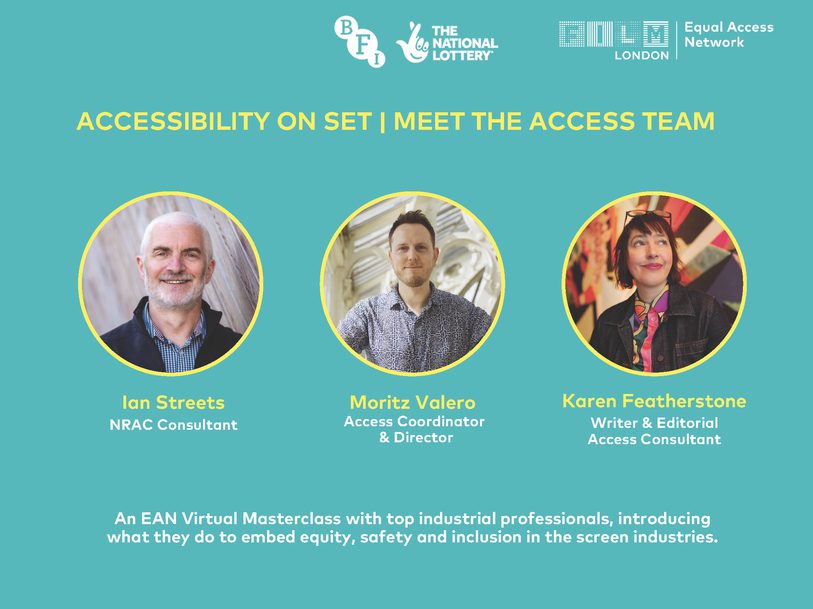
On Thursday the 26 of June 2025, the Skills Team were thrilled to be joined by three members of Cassarotto Ramsay & Associates��� Access Team. The trio each shared what they do in their inclusivity-focussed roles, when working with Deaf, Disabled, and Neurodivergent (DDN) communities in Film and TV.
The guest panellists were:
- Ian Streets | NRAC Consultant. His 20+ year experience of rating how accessible a location/set is to navigate, has included auditing TV studio tours of Coronation Street and Emmerdale, 60 / 40 Productions Offices, and the O2 Arena.
- Karen Featherstone | Writer & Editorial Access Consultant (EAC). She ensures productions and script teams portray DDN characters accurately. Karen, who firstly trained as an Access Coordinator on Dragon���s Den and University Challenge, is also a script reader. She has read for the BFI, the BBC Comedy Unit, and is currently reading for Channel 4 New Writers.
- Moritz Valero | Access Coordinator & Director. Ever since directing the Paralympic inspired short film Take Your Mark - pre-dating Jack Thorne���s pledge to industry for the need of Access Coordinators - Moritz has fulfilled this very role on numerous productions. These include Never Mind the Buzzcocks, Britain's Got Talent and The Assembly.
A wealth of knowledge was shared with participants during the discussion, which was moderated/organised by Kadijha Kamara and Sashi Gopalakrishnan of the Skills Team. Ian signposted people to the , who are a membership group, where one can attend meetings about designing accessible buildings.
Meanwhile, Karen spoke highly of the Disabled-led organisation called , who work with people and families impacted by spinal cord injuries; they have also consulted on soap operas.
Amongst the participants who joined the webinar, were UKTV representatives, and also a Film Producer/Filmmaker, who asked for advice on where to recruit DDN talent. Moritz recommended , as an agency to connect with behind the camera talent.
For small productions looking to embed an access budget, Ian encouraged participants that ���things don���t have to cost a fortune,��� Practices one should consider are, ���How do you arrive at sites? Where���s the nearest bus stop? How do you get from the bus stop to the entrance? What is the process of going through security? How accessible is that? Follow that journey all the way through ��� to the backlot, to the toilets, to the canteen.���
Karen���s career has grown into ���a perfect confluence ��� my love of script and my identity as a Disabled person.��� However, with there still being a lack of representation, and inaccurate portrayals of people on screen from DDN communities, she emphasised that ���if writers and filmmakers don���t think about representing humanity in all its depth and angles, it���s a shame for the script and a missed chance to evolve stereotypes.���
Moritz further complimented Karen���s point: ���Disabled people make up about 20% of the population, so it���s not a minor group. It���s one of the biggest missed opportunities for representation, and there���s also the ���Purple Pound������the collective spending power of people with disabilities - who aren���t represented accurately on screen, or behind the camera.���
Thank you to all our guest speakers, participants, and Sara Johnson & Julie Fernandez for shaping what was an honest and supportive discussion.